content top

The end of the Log

The previous entry was the last entry in the log book. It is our understanding that orders came out prohibiting any logs of this kind to be kept.  The following posts reflect only ship movements, no text accompanied these entries.

All of the text following is from the USS West Virginia’s history page.

Read More

USS West Virginia assists with the landing on Okinawa


View larger map

USS West Virginia Firing on Okinawa as the Marines land

Joining TF 64 for the invasion of the Okinawa Gunto area, West Virginia sailed on March 21, reaching her objective four days later on the 25th. In fire support section one, West Virginia spent the ensuing days softening up Okinawa for the American landings slated to commence on April l. At 1029 on March 26, lookouts reported a gun flash from shore, followed by a splash in the water some 6,000 yards off the port bow. Firing her first salvoes of the operation, West Virginia let fly 28 rounds of 16- inch gunfire against the pugnacious Japanese batteries.

The following day, the “Wee Vee” fought against enemy air opposition, taking a “Frances” under fire at 0520. The twin-engined bomber crashed off the battleship’s port quarter–the victim of West Virginia’s anti-aircraft guns. Over the days that followed, enemy opposition continued in the form of suicide attacks by Japanese planes. Mines, too, began making themselves felt; one sank the minesweeper Skylark (AM-68), 3,000 yards off West Virginia’s port bow at 0930 on the 28th.

After taking on ammunition at Kerama Retto–the island seized to provide an advance base for the armada massing against Okinawa– West Virginia sailed for Okinawa to give direct gunfire support to the landings. Scheduled to fire at 0680, the battleship headed for her assigned zone off the Okinawa beaches. While en route, though, at 0455, she had to back down all engines when an unidentified destroyer stood across her bow, thus avoiding a collision.

As she prepared to commence her bombardment, West Virginia spotted a Japanese plane off her port quarter her antiaircraft batteries tracked the target and opened fire, downing the enemy aircraft 200 yards away. Four more enemy planes passed within her vicinity soon thereafter–West Virginia claimed one of them.

Finally, at 0630, West Virginia opened fire as landing craft dotted the sea as far as the eye could reach, all heading for the shores of Okinawa. West Virginia’ssailors, some 900 yards off the beaches, could see the craft heading shoreward like hundreds of tadpoles; at 0842, lookouts reported seeing some of the first troops going ashore. The battle for Okinawa was underway.

West Virginia continued her bombardment duties throughout the day, on the alert to provide counter-battery fire in support of the troops as they advanced rapidly inland. There appeared to be little resistance on April 1, and West Virginia lay to offshore, awaiting further orders. At 1903, however, an enemy plane brought the war down on West Virginia.

The battleship picked up three enemy planes on her radar and tracked them as they approached; flak peppered the skies but still they came. One crossed over the port side and then looped over and crash-dived into West Virginia, smashing into a superstructure deck just forward of secondary battery director number two. Four men were killed by the blast, and seven were wounded in a nearby 20-millimeter gun gallery. The bomb carried by the plane broke loose from its shackle and penetrated to the second deck. Fortunately, it did not explode and was rendered harmless by the battleship’s bomb disposal officer. Although her galley and laundry looked hard-hit, West Virginia–reporting her damage as repairable by ship’s force–carried on, rendering night illumination fire to the marines ashore.

West Virginia buried her dead at sea in the wake of the kamikaze attack of April 1 and resumed her gun-fire support duties soon thereafter. In the course of her tour off shore in early April, she shot down a “Val” on the 6th.

In early April, the Japanese attempted to strike at the invasion fleet in a last gasp offensive formed around the super- battleship Yamato. On the night of April 7 and 8, West Virginia steamed north and south in the waters west of Okinawa ready to intercept and engage the Japanese surface force headed her way. The next morning, 8 April, Commander, TF 68, reported that most of the ships in that enemy force had been sunk including Yamato, whose last sortie had been made with enough fuel to get her to Okinawa–but not to return, Thus, the Japanese Navy’s largest kamikaze perished–any miles short of her objective.

For West Virginia, however, her duties went on, providing illumination and counterbattery fire with both main and secondary batteries and giving her antiaircraft gunners a good workout due to the heavy presence of many suiciders. Her TBS crackled with reports of ships under attack and damaged–Zellars (DD-777),Tennessee, Salt Lake City (CA-24), Stanley (DD-478)–and others, all victims of the “divine wind,” or kamikaze. Her shore bombardments elicited nothing but praise from those enjoying the benefits of the ship’s firing; one spotter reported happily on April 14: “You’re shooting perfectly, you could shoot no better, no change, no change,” and, “Your shooting is strictly marvelous. I cannot express just how good it is.” She delivered sterling support fire for the 6th Marines upon that occasion; later, she continued in that fine tradition for the 10th Army and the XXIVth Army Corps.

West Virginia continued fire support for the Army until April 20, at which point she headed for Ulithi, only to turn back to Okinawa, hurriedly recalled because ofColorado’s (BB-45) suffering damage when a powder charge exploded while she was loading powder at Kerama Retto. Returning to Hagushi beach, West Virginiafired night harassment and interdiction fire for the 10th Army and the XXIVth Army Corps. Ultimately, West Virginia sailed for Ulithi, in company with San Francisco (CA-38) and Hobson (DD-464), reaching her destination–this time without a recall en route on April 28.

Returning to Okinawa after a brief sojourn at Ulithi, West Virginia remained in support of the Army and the Marines on the embattled island into the end of June. There were highlights of the tour–on June 1, she sent her spotting plane aloft to locate a troublesome enemy blockhouse reportedly holding up an Army advance. A couple of rounds hurled in the enemy’s direction produced no results; she had to settle for obliterating some of the enemy’s motor transport and troop concentrations during the day instead. The next day, June 2, while in support of the Army’s XXIVth Corps, West Virginia scored four direct hits and seven near-misses on the blockhouse that had been hit the day before.

West Virginia then operated off the southeast coast of Okinawa, breaking up Japanese troop concentrations and destroying enemy caves. She also disrupted Japanese road traffic by scoring a direct hit on a road intersection and blasted a staging area. On 16 June, she was firing an assignment for the 1st Marines off southwestern Okinawa when her spotting plane, a Vought OS2U Kingfisher, took hits from Japanese antiaircraft fire and headed down in flames, her pilot and observer bailing out over enemy- held territory. Within a short time, aided by Putnam (DD-757) and an LCI, West Virginia closed and blasted enemy guns in an attempt to rescue her plane crew who had “dug in for the day” to await the arrival of the rescuers. The attempt to recover her aircrew, however, was not successful. Loaned a Kingfisher from Tennessee, West Virginia kept up her gunfire support activities for the balance of June.
Read More

USS West Virginia takes on replacements


View larger map
Shifting to San Pedro Bay, Leyte, at the end of June, the battleship reached her destination on July 1, escorted by Connolly (DE-306). There, on the morning of July 5, she received her first draft of replacements since Pearl Harbor in 1944. After loading ammunition, West Virginia commenced training in the Philippine area, an activity she carried out through the end of July.
Read More

USS West Virginia at Okinawa during the dropping of the atomic bombs


View larger map

Sailing on August 3 for Okinawa, West Virginia reached Buckner Bay on the 6th, the same day that the first atomic bomb was dropped on the city of Hiroshima. Three days later, a second bomb obliterated the greater part of the city of Nagasaki. Those two events hastened Japan’s collapse. On August 10, at 2115, West Virginia picked up a garbled report on radio that the Japanese government had agreed to surrender under the terms of the Potsdam Declaration, provided that they could keep the Emperor as their ruler. The American ships in Buckner Bay soon commenced celebrating–the indiscriminate use of antiaircraft fire and pyrotechnics (not only from the naval vessels in the bay but from marines and Army troops ashore) endangering friendly planes. Such celebrations, however, proved premature–at 2004 on August 12, West Virginia sailors felt a heavy underwater explosion; soon thereafter, at 2058, the battleship intercepted a radio dispatch fromPennsylvania (BB-38) reporting that she had been torpedoed. West Virginia sent over a whaleboat at 0023 on the 13th with pumps for the damagedPennsylvania.

Read More

The USS West Virginia is present in Tokyo Bay for the Japanese Surrender


View larger map

Anchored in Sagami Wan, Japan, outside of Tokyo Bay, circa late August 1945. Mount Fuji is in the background

The war ended on August 15, 1945. West Virginia drilled her landing force in preparation for the upcoming occupation of the erstwhile enemy’s homeland and sailed for Tokyo Bay on the 24th as part of TG 35.90. She reached Tokyo Bay on the last day of August and was thus present at the time of the formal surrender on September 2, 1945. For that occasion, five musicians from West Virginia’s band were transferred temporarily to Missouri (BB-63) to play at the ceremonies.

West Virginia played her part in the occupation, remaining in Tokyo Bay into September of 1945, weathering a storm on the 15th that had winds clocked at 65 knots at one point. On September 14, she received on board 270 passengers for transportation to the west coast of the United States. She got underway at midnight on the 20th bound for Okinawa as part of TG 30.4. Shifting to Buckner Bay on the 23d, the battleship sailed for Pearl Harbor soon thereafter, reaching her destination on 4 October.

The USS West Virginia stands in the background as the Japanese surrender.

Read More

Dale Rogers returns to the continental United States and is honorably discharged from the Marine Corps.


View larger map
There, the crew painted ship and kept on board only those passengers slated for transportation to San Diego, Calif. Bound for that port on the 9th, West Virginiamoored at the Navy Pier at San Diego at 1328 on October 22. Two days later, Rear Admiral I. C. Sowell hauled down his flag as Commander, BatDiv 4.

Dale Ritchie Rogers was discharged from the Marine Corps Reserve on October 30, 1945, 1 day before his 3rd anniversary.

Read More

1975 History

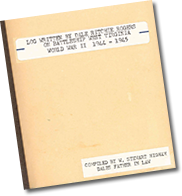
Before writing the story in Dale’s Log, I had asked him to write of his experiences while he was in the service, He wrote the following while he was sick, He did not get to finish but it adds a personal note to the rest of the story.

There was an error in the date of his enlistment in the book. At the start of the book it reads he enlisted the 19 August 1944 it should read 1942.

W. Stewart Higham

On August 19, 1942 I enlisted in the United States Marine Corps. I was one of sixty men that volunteered to serve their country.

The sixty men were all members of the L.D.S. Church and they all lived in the states of Utah, Idaho and Nevada. We were called the “Second Mormon battalion”. We all remained together until after ‘Boot Camp.

I went to Sea School and learned about ship.

In November 1942 I went to Pearl Harbor, on the oldest troop transport with 2000 other Marines.

Sixty of us got off the ship at Pearl Harbor and the rest went on to Guadalcanal.

At Pearl Harbor, I was assigned to the U.S.S. West Virginia.

I spent my first Christmas away from home, swimming on the Beach at Waikiki. I also spent my Honeymoon there”alone”. I had been married on October 31, 1942.

The first time I went aboard the ship which was to be my “home away from home” for the next three and a half years, they were still pumping water out of the ship, as it was still on the bottom of the harbor where she was sunk in the sneak attack on December 7, 1941.

March 1943, the West Virginia was afloat again and under her own power. We went to Bremerton, Washington, where the ship went into dry dock for about six months. At that time they rebuilt the ship from the second deck up. The men worked on the ship 24 hours a day.

At the same time men were working on all the ships that were sunk at Pearl Harbor, on Dec.7th.

During this time Kay, had come to Bremerton, to stay with me, while the work was going on. We lived on a hill across the bay.

After the ship was ready for sea duty and we were steaming out the bay, I looked back at the top or the hill and I could see Kay, waving a table cloth that she had been sewing on. It was about 3 years before I saw Kay, Again.

When we were out to sea we learned that we were in the 7th Fleet, which was made up from all the battleships that could be saved, from the attack at Pearl Harbor on December 7th.

The 7th Fleet, consisted of 7 Battleships, 4 Carriers, 6 Heavy Cruisers, 6 Light Cruisers and about 20 Destroyers. We are now a full force Task Force.

After we left Bremerton, we went to Long Beach and had gunnery practice, then we were told we were on our way to the war in the South Pacific.

On our way to the war we went to Pearl Harbor. This is where they filled the ship with all the things we needed like food, ammunition and fuel. It took three days and nights to get the ship loaded.

We were on our way. Every night the Chaplain would talk to the the men and then he would say a prayer. We had been at sea about 2 weeks and the Chaplain started wondering when we were going to see some action. Can you believe when we finally got into action the Chaplain was the first to crack.

USS West Virginia Navy Chaplain

On a battleship there are a lot or men, 2000 Sailors, 200 Navy officers and 60 marines plus 3 Marine Officers. Most of the Marines were assigned to the 40 millimeter Anti-Aircraft guns. That put us upon the superstructure where we could see everything that was happening.

We find that we are going to the Philippines, to help liberate some or the men that were taken prisoners at Wake island and those that were in the Bataan Death march.

When the 7th Fleet went to Leyte, to begin shelling the beach so the Marines and the Army could make a landing, the West Virginia was was flying the same flag she was  flying on December 7th 1941 when she sank at Pearl Harbor.

The first shot that was fired from a ship at Leyte Gulf, to get the, land, back,was fired by the West Virginia. We shelled the beach for three days and nights.

Bright and early on the morning of the fourth day there were so many ships on the horizon that
you could not count them.

The landing craft were on their way to the beaches. I still feel lucky that I never had to make a beach landing. That’s where the real war is.

We left Leyte and went to Luzon. We shelled Luz0n, for three days and nights. Then, the Marines would land and we would just stay in the bay and fire the Main Battery (16-inch guns) at special targets. When the l6-inch guns fire you can see the bullet go through the air until it explodes on the land.

About the time we were starting to see enemy planes, the orders were for everyone to stay inside when the big guns were fired. But when the planes started to come in, we had to be outside. This was was a problem. They asked the Marines to go outside and they would fire one round to see if it was safe. We laid flat on the deck. I laid and they fired the first shot. We said we were O.K. They then tired two guns at once. No Problem. Then they fired all eight guns at once and we were standing up watching the smoke billow out of the guns. We were all heroes.

We started to see more and more Jap planes now. They would not come very close to the ships.

This was as far as Dale was able to write. We did not locate these notes until after the booklet was printed.

Read More
content top